20-Step Startup Launch Checklist to Validate & Sell Fast

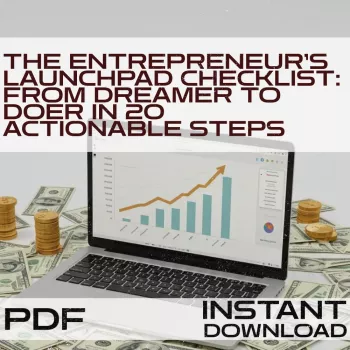
The Entrepreneur’s Launchpad Checklist: From Dreamer to Doer in 20 Actionable Steps
Big ideas become real businesses through focused execution. A solid checklist turns “someday” into a sequence of decisions you can make quickly—validating demand, defining an offer, launching with confidence, and then improving based on real signals (not guesses). The goal is simple: replace overwhelm with momentum, so progress is visible from day one.
If you want a structured, printable/digital path you can revisit every time you test a new offer, explore The Entrepreneur’s Launchpad Checklist digital download.
What this checklist helps accomplish (and who it’s for)
- Turns a vague business idea into a defined plan with concrete next actions.
- Creates a repeatable launch routine: validate → build → launch → learn.
- Helps first-time founders prioritize what matters and avoid busywork.
- Useful for side hustles, service businesses, digital products, and early-stage startups.
- Works best when paired with a weekly review habit and simple metrics.
It’s especially helpful if you’ve been “researching” for weeks, tweaking branding endlessly, or building features before you’ve proven anyone will pay.
The 20-step launch path: a practical overview
The fastest launches aren’t rushed—they’re focused. This path keeps attention on the decisions that create clarity and revenue signals.
- Clarify the problem: define the customer pain, the stakes, and the current workaround.
- Identify the ideal customer: narrow by scenario, budget, urgency, and decision factors.
- Write a one-sentence value proposition: outcome + audience + differentiator.
- Validate demand quickly: interviews, pre-orders, waitlists, or small paid tests.
- Choose a business model: services, productized service, digital product, subscription, or hybrid.
- Define the minimum viable offer: what’s included, excluded, and the delivery timeline.
- Set pricing with intent: anchor to value, test willingness to pay, avoid underpricing.
- Map the customer journey: awareness → consideration → purchase → onboarding → retention.
- Create a simple brand foundation: name checks, basic messaging, visual consistency.
- Pick launch channels: one primary (focus) and one secondary (support).
Launch steps mapped to outcomes
| Step focus | What gets decided | Simple output to produce |
|---|---|---|
| Problem + customer | Who it helps and why it matters | Ideal customer snapshot + problem statement |
| Validation | Whether real demand exists | 10 conversations or a small paid test result |
| Offer + pricing | What’s being sold and for how much | One-page offer description + price range |
| Launch plan | How people will discover and buy | Channel plan + 2-week launch calendar |
| Measurement | What success looks like | 3 metrics and a weekly review checklist |
For deeper planning frameworks, the U.S. Small Business Administration’s business plan guidance and SCORE’s templates are solid references. For keeping your first version intentionally lean, Harvard Business Review’s refresher on minimum viable product thinking helps reinforce the “test before you build” mindset.
Turning steps into action: a 7-day starter sprint
If you want traction fast, run a one-week sprint that produces visible artifacts—documents, scripts, pages, or test results—rather than vague intentions.
- Day 1: choose one customer segment and write a clear problem statement.
- Day 2: draft the value proposition and list assumptions that must be true.
- Day 3: run quick validation outreach (messages, calls, forum posts, small ad test).
- Day 4: define the minimum viable offer and delivery method (how it will be fulfilled).
- Day 5: set a starter price and write the simplest sales page outline (headline, benefits, proof, CTA).
- Day 6: build a basic checkout or intake flow (payment link, booking form, or email capture).
- Day 7: publish a launch post and invite the first 10–25 people to respond or join a waitlist.
The point isn’t perfection—it’s learning. Even a “no” teaches you what to adjust: who you’re talking to, what you’re promising, or how you’re packaging delivery.
Common launch traps the checklist is designed to prevent
- Overbuilding before validation: investing weeks in features no one asked for.
- Targeting “everyone”: messaging becomes generic and conversion drops.
- Pricing by fear: charging too little and attracting mismatched customers.
- Channel overload: trying five platforms at once and mastering none.
- No follow-up system: losing leads due to missing reminders and next steps.
- Skipping measurement: not knowing what to repeat, stop, or improve.
A checklist works best when it forces decisions. A decision creates a next action. A next action creates a result you can measure.
How to use the digital download for consistent progress
If you want a single place to track the key decisions—problem, customer, offer, price, channels, and metrics—use The Entrepreneur’s Launchpad Checklist digital download as your operating system for each new test.
Related checklists that pair well with a startup launch
To pair launch execution with a minimalist money routine, consider the Zen-Savvy Savings Checklist alongside your launch plan—especially if you’re building a side hustle and want clean guardrails for spending and savings.
FAQ
Is this checklist better for brand-new founders or people already running a business?
It works for both. Brand-new founders can use it to move from idea to a first paid offer, while existing businesses can use it to relaunch, validate a new offer, or tighten messaging and channels that have gone stale.
How long does it take to get through the 20 steps?
A focused sprint can take 1–2 weeks for a simple service or small digital offer, while more complex products typically take 3–6 weeks. The timeline depends on how quickly you validate and how many iteration cycles you run.
Do the steps require paid tools or a big budget?
No—most steps can be completed with free or low-cost tools like documents, forms, email, and simple checkout links. The process prioritizes small tests before you invest in bigger software, branding, or builds.















Leave a comment